
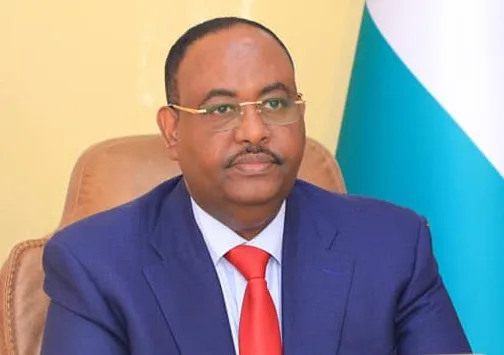
Said Abdullahi Deni is formally an elected president, but many of his governing practices resemble those of an increasingly authoritarian figure. His administration has used parliamentary mechanisms to marginalize dissenting MPs, employed intelligence and judicial bodies to pressure critics, and overseen a restrictive environment for journalists and media outlets. Currently Puntland, under Deni’s leadership, is shaped by intimidation. Deni maintained the outward structures of democracy while exercising power in ways that narrowed political space and constrained genuine contestation.
Parliament as a tool to silence critics
On 3 December 2020, Puntland’s House of Representatives voted by a large majority to remove the parliamentary immunity of eight members, accusing them of violating standing orders and the code of conduct. The region’s High Court later endorsed the decision, effectively expelling these lawmakers from political life. Officially framed as a disciplinary action, the move appeared political in nature, as all targeted MPs belonged to a bloc critical of President Deni. It occurred at a time when concerns were rising over the growing concentration of power within the executive. Once stripped of immunity, the MPs were exposed to prosecution and political pressure, leading several to withdraw from public life.
Rather than serving as a forum for debate and oversight, parliament became a mechanism for consolidating executive authority. The removal of outspoken critics through legal procedures sent a clear message to the remaining legislators: allegiance would be rewarded, while dissent would be punished.
Weaponizing the courts and security apparatus
Parliament was only one component of a broader strategy. The judiciary and security agencies, particularly the Puntland Intelligence and Security Agency (PISA), played an equally significant role. The case of freelance journalist Kilwe Adan Farah provides a stark example. Kilwe was arrested by PISA officers on 27 December 2020, a day after reporting on anti-inflation protests in Garowe. Amnesty International and other human rights groups later described his treatment as an abuse of power. He was tried before a military court, despite being a civilian, and convicted on charges such as “publication of false news” and “bringing the state into contempt.” The UN Working Group on Arbitrary Detention concluded that his detention violated international human rights standards.
In a democratic system, courts and intelligence agencies are intended to protect citizens’ rights and uphold the rule of law. Critics argue that under Deni, these institutions were often used to intimidate opponents and silence dissent. When MPs lose immunity and journalists face military trials, the line separating normal political competition from authoritarian practices becomes increasingly blurred.
A sustained assault on media freedom
Independent media is essential to any functioning democracy, yet Puntland under Deni has frequently been cited for its deteriorating press environment. In March 2021, Amnesty International warned of a surge in journalist arrests, characterizing it as an “escalating crackdown on media freedom.” Patterns reported by Somali journalist unions and local outlets included arbitrary detention of reporters covering protests, corruption, or sensitive political issues; legal harassment through vague accusations such as spreading false information or undermining state institutions; and pressure on media houses, ranging from official warnings to raids and closures.
The result has been a climate in which many journalists avoid reporting fully and accurately, not because of explicit censorship laws, but because fear and uncertainty encourage self-censorship. A leader who tolerates or benefits from such conditions is not simply maintaining security: he is presiding over a systematic reduction of public space.
Elections under the shadow of coercion
Supporters of Deni correctly note that he has won elections, including his re-election in 2024. However, the presence of elections does not automatically guarantee democratic practice, especially when the political environment is shaped by intimidation. Before municipal and local elections, civil society groups repeatedly warned that dissent was being discouraged. In May 2023, the Puntland police chief publicly threatened to suppress anyone who sought to “disrupt” the municipal vote, using language that blurred distinctions between peaceful opposition and criminal activity.
When opposition lawmakers know their immunity can be revoked, journalists risk detention for reporting on protests, and security officials speak openly of “attacking” those who oppose the process, elections risk becoming symbolic exercises rather than genuine political choices.
Many scholars describe such systems as “competitive authoritarianism”: elections are held, but the playing field is sharply tilted in favour of the incumbent. The ballot box exists but is surrounded by fear, patronage, and coercive power.
Leave a Reply