
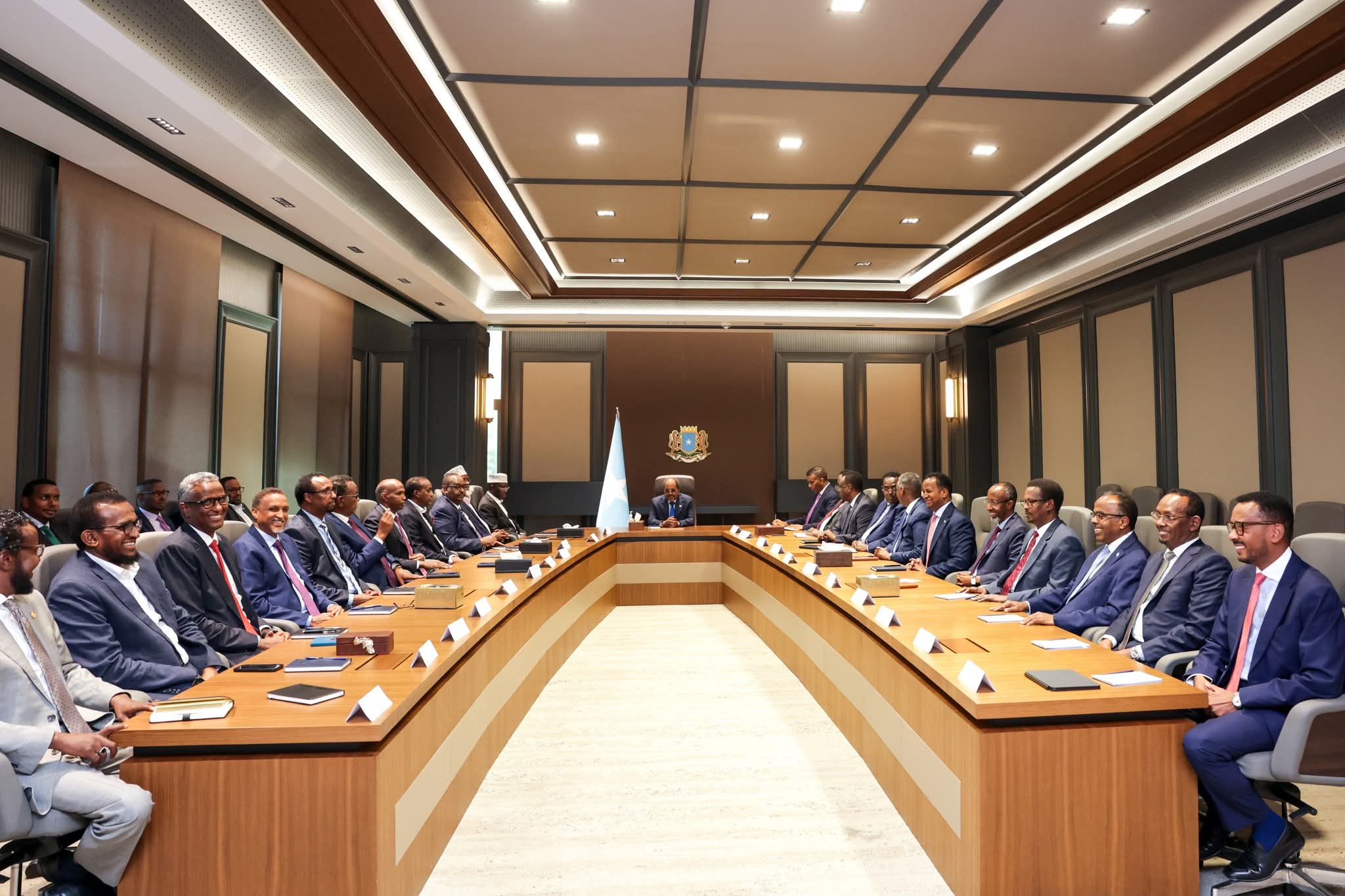
A high-level political meeting is scheduled to reconvene today at Villa Somalia, the Presidential Palace in Mogadishu, bringing together senior leaders of the Federal Government of Somalia (FGS) and members of the Somali Future Council.
The session, convened by President Hassan Sheikh Mohamud, is expected to be attended by Prime Minister Hamza Abdi Barre and his deputy, the leaders of Puntland and Jubbaland, former national leaders, and representatives from federal institutions. The agenda is set to focus on the country’s overall political situation, with particular emphasis on the protracted disagreements surrounding the electoral process and the ongoing review of the Provisional Constitution.
The Somali Future Council, which held consultations in Mogadishu on Saturday, resolved to attend the meeting at Villa Somalia as a unified bloc in order to continue dialogue on electoral matters. The Council’s participation follows reports that the Presidency declined to formally engage with a committee previously appointed by the group to discuss elections. Efforts to address the dispute through separate consultations are understood to have failed to yield consensus.
In its latest position, the Council has called for indirect elections with broader representation than previous models to be held before May. It further stressed that its members are united on this proposal and urged that elections also be conducted in South West State, Galmudug, and Hirshabelle, where the mandates of regional administrations have expired.
For its part, the Federal Government continues to prioritise constitutional amendments and maintains its position in favour of nationwide, one-person-one-vote parliamentary elections, to be administered by the National Elections Commission in accordance with the proposed constitutional framework.
According to political sources, one option reportedly under consideration is a potential reversion to an elder-mediated selection model—similar to the 2012 process—should universal suffrage prove unattainable. Such a model would involve traditional elders in the selection of members of parliament.
The outcome of today’s meeting is expected to shape the next phase of Somalia’s electoral roadmap and broader political transition.
Leave a Reply